Research at Kawabe Laboratory
Our research focuses on contaminant transport and geochemical and biological processes in soils, groundwater, and river systems. We integrate field investigations, laboratory experiments, and numerical simulations to develop remediation technologies and evaluate environmental and human-health risks.
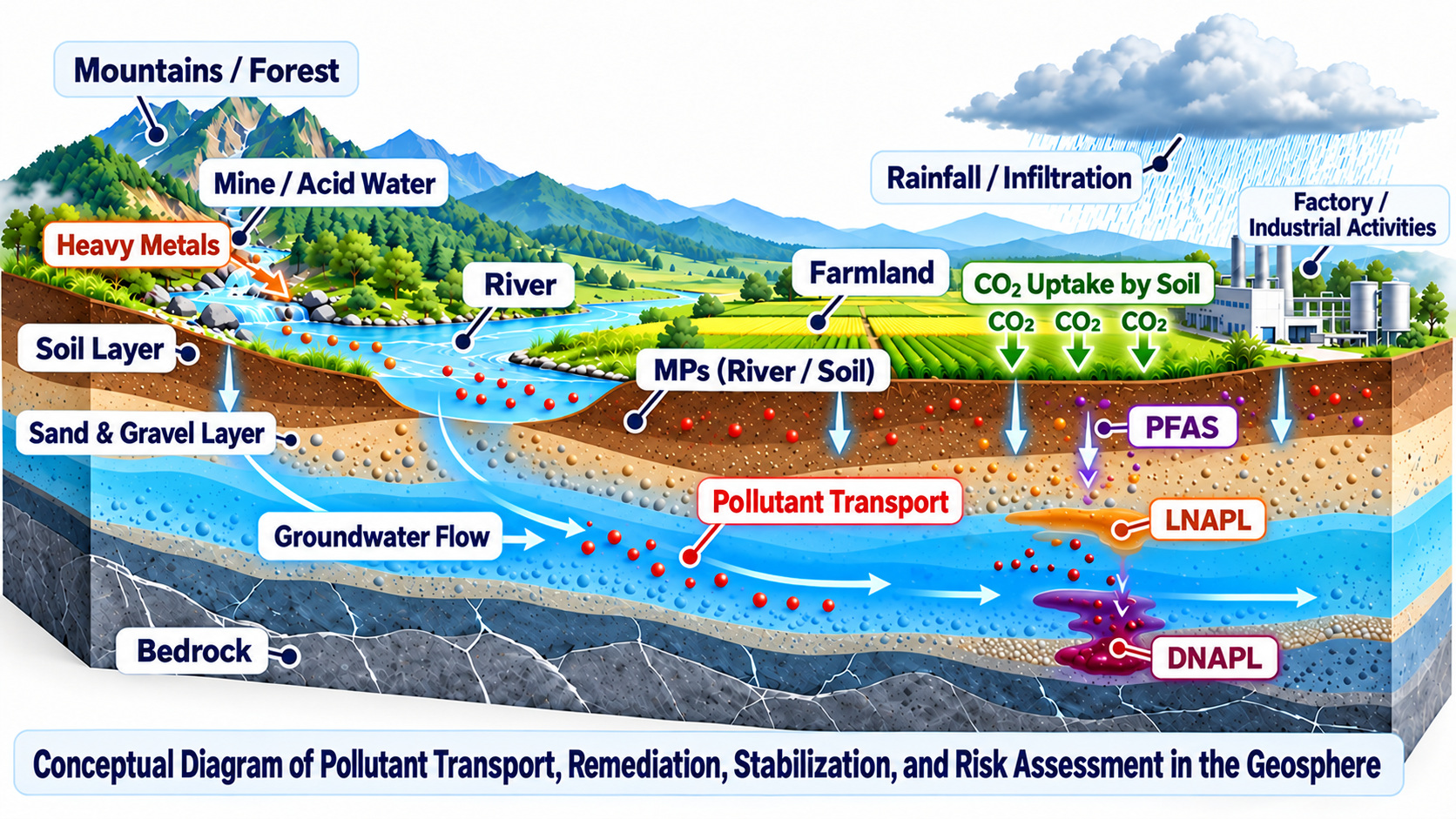
Our work addresses heavy metals and metalloids, naturally occurring contaminants, per- and polyfluoroalkyl substances (PFAS), volatile organic compounds (VOCs), and micro- and nanoplastics. For organic contamination, we also consider the environmental behavior of dense and light non-aqueous phase liquids (DNAPL and LNAPL).
We study how these substances move, react, persist, or attenuate in the environment. In parallel, we investigate low-cost and resource-efficient remediation methods using natural minerals, eggshells and other shells, industrial by-products, and microorganisms. Related work includes soil CO₂ uptake and mineral carbonation.
Main Research Topics
Micro- and Nanoplastic Transport in the Geosphere
We investigate adsorption, aggregation, and transport of micro- and nanoplastics in rivers and soils through laboratory experiments and numerical modeling.
Acidic Rivers and Mine-related Contamination
We study changes in water chemistry and the mobilization, precipitation, and remobilization of potentially toxic elements, including arsenic and zinc, in river water and sediments.
Remediation Using Natural Materials, By-products, and Microorganisms
We examine neutralization, contaminant removal, immobilization, and biodegradation using eggshells, shells, steelmaking slag, natural minerals, and microbial processes.
PFAS Transport and Multi-pathway Exposure Assessment
We evaluate transport from soil to groundwater, air, and crops, and assess how chemical properties and environmental variability affect potential exposure and risk.
Organic Contaminants and Monitored Natural Attenuation
We examine the transport and transformation of VOCs and chlorinated solvents, including microbial reductive dechlorination, with attention to DNAPL and LNAPL behavior and monitored natural attenuation (MNA).
CO₂ Uptake, Mineral Carbonation, and Environmental Modeling
We investigate soil CO₂ uptake and mineral carbonation and develop transport–reaction simulations and data-analysis methods to support environmental assessment.